
The Cathedral of Saint Andrew (Duomo di Sant'Andrea) is the principal Catholic place of worship in Amalfi. Dating back to the 9th century, this architectural masterpiece showcases a fascinating evolution of styles, ranging from Romanesque to Baroque and Rococo.
While the predominant style is Arab-Norman Romanesque, the structure has been remodeled several times over the centuries, incorporating Byzantine, Gothic, and Baroque elements. The cathedral complex includes the adjoining Basilica of the Crucifix (also dating to the 9th century), the Crypt of Saint Andrew, and the famous Cloister of Paradise.
When to Visit
The cathedral's opening hours vary depending on the time of year. From March to June, it is open continuously from 9:00 AM to 6:45 PM, while during the summer months of July through September, the closing time is extended to 7:45 PM. In the winter season, from November to February, visiting hours are split: the cathedral is open from 10:00 AM to 1:00 PM and reopens in the afternoon from 2:30 PM to 4:30 PM. Admission tickets cost €3.00, with a reduced rate of €1.00 available for minors and seniors over the age of 65.
Interior
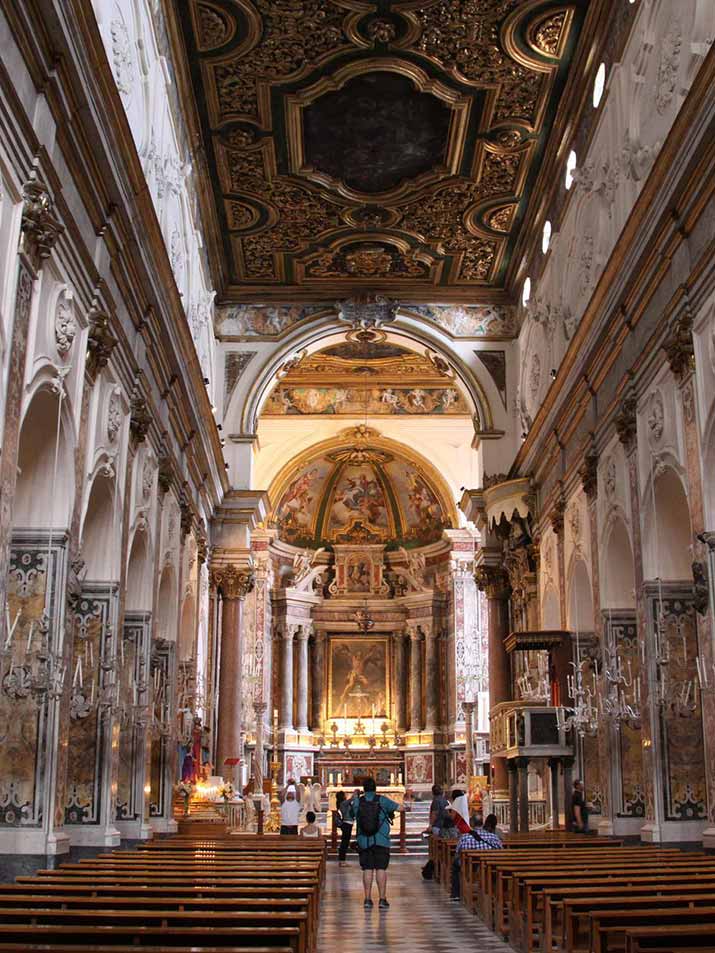
Inside, the cathedral features a magnificent coffered ceiling and a central nave housing a large 13th-century wooden crucifix and a painting of the Martyrdom of Saint Andrew above the altar. Two majestic Egyptian granite columns support the main arch, flanked by smaller columns and two pulpits.
In the left aisle, you will find a mother-of-pearl cross, brought from the Holy Land by Monsignor Marini, and a red Egyptian porphyry baptistery. The side chapels display paintings by Silvestro Mirra and his students. The right aisle houses the 16th-century reliquary bust of Saint Andrew, while a large canvas depicting Saint Andrew and Saint Matthewhangs over the door.
Exterior
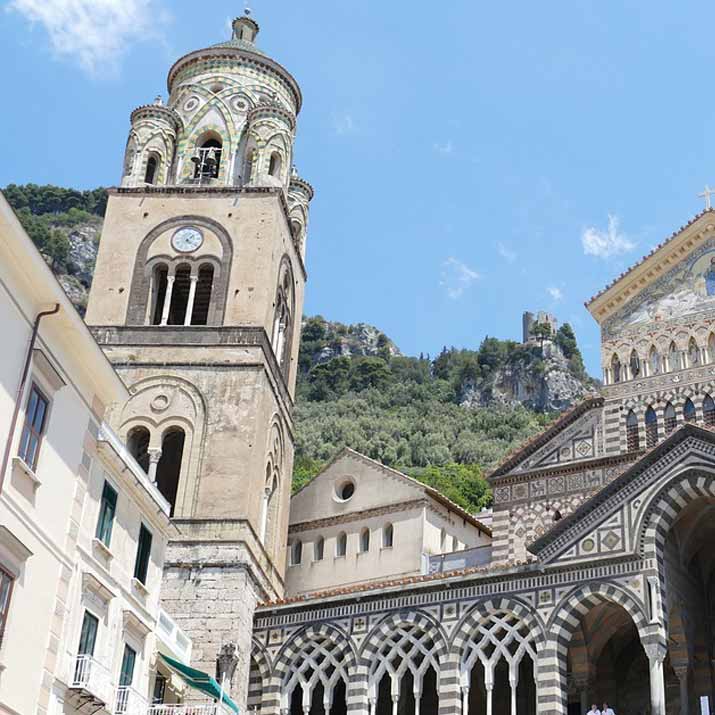
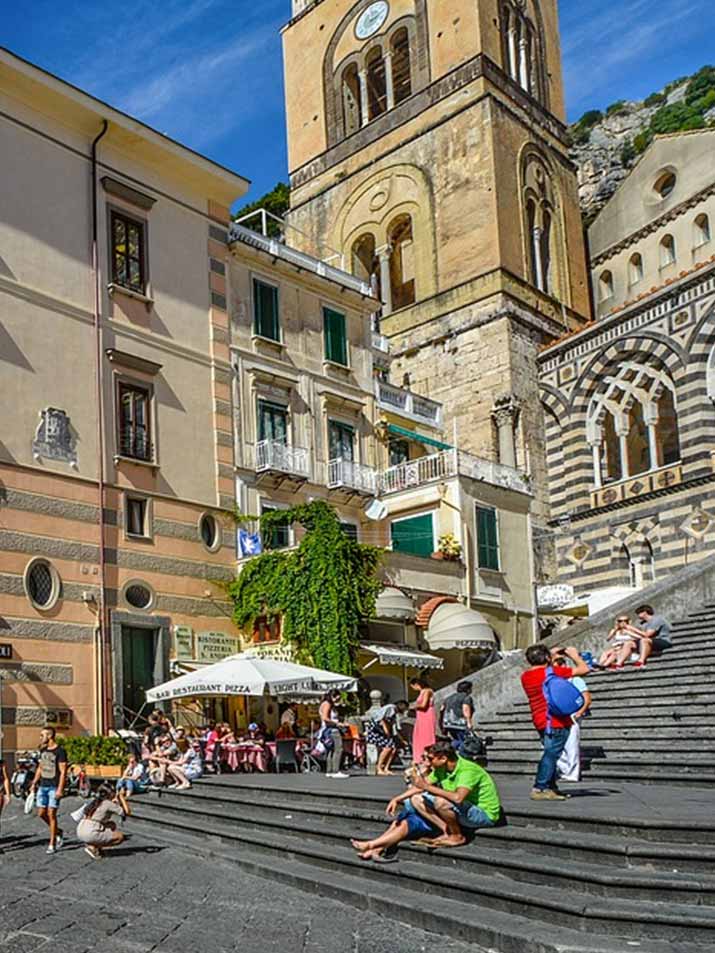
The building dominates the town from the top of a grand staircase of 57 steps. At the summit, the façade dazzles with a famous mosaic rich in bright colors, depicting Christ Enthroned amidst the Evangelists.
The cathedral boasts a splendid Romanesque bell tower, completed in 1276 and restored in 1929, covered in vibrant majolica tiles. Beyond the portico stand the cathedral's bronze doors, cast in Constantinople and gifted by an Amalfitan patrician.
The Crypt
The Crypt safeguards the remains of Saint Andrew, the first disciple of Jesus and the patron saint of Amalfi. According to tradition, after his martyrdom, his relics were moved from Patras to Constantinople. Local legends say the relics were sold by the Romans, remaining there until 1208. During the Fourth Crusade, Cardinal Pietro Capuano, a native of Amalfi, brought the relics to the city.
Today, the crypt appears in its Baroque form (dating back to the 1600s), featuring scenes of the Passion of Jesus surrounded by elegant stucco decorations. The central altar, crafted from precious marble by Domenico Fontana, sits above the silver urn containing the sacred relics. A large bronze statue by Michelangelo Naccherino stands nearby, flanked by marble statues of Saint Lawrence and Saint Stephen.
History
The history of the Amalfi Cathedral begins in the 9th century under Duke Mansone I. It was built next to a pre-existing basilica (the Basilica of the Crucifix), which itself stood on the ruins of a paleochristian temple. Initially separate, the two places of worship were merged into a single six-nave Romanesque church shortly after the year 1000. However, starting in 1266, the left nave of the Basilica of the Crucifix was demolished to make room for the Cloister of Paradise (Chiostro del Paradiso), a cemetery for Amalfi’s noble families.
The cathedral faithfully reflects the history of Amalfi. It is infused with architectural styles ranging from the Romanesque bell tower to Baroque and Rococo interiors, with strong Arab-Byzantine influences—a sign of the commercial and political autonomy Amalfi enjoyed as a Maritime Republic and the various dominations it subsequently underwent.
Over time, the cathedral underwent several transformations. The two churches were separated once again, and the Basilica of the Crucifix (the oldest part) can still be visited today. Following alterations in the 16th and 17th centuries, a major renovation became necessary after strong winds in 1861 destroyed part of the already deteriorating façade.
The current façade decorations, including the mosaics of Christ and the Evangelists by Domenico Morelli, were reconstructed after this collapse. The atrium now serves as a link connecting the Cloister of Paradise, the ancient Basilica of the Crucifix, and the Romanesque bell tower. Viewed from Piazza Duomo below, at the foot of the steps leading to the bronze doors, the cathedral continues to astonish visitors as one of Italy’s most fascinating architectural spectacles.